
Groupshow
White over blue, red and yellow

White over blue, red and yellow; exhibition view, Wschód Naples, 2026
Advertisement


Antonia Brown: GG I (2026; paper, organdy cotton, alum, oak gall, silver leaf, pen drawing, photocopy, tape; 40 x 60 x 3 cm), Wschód Naples, 2026

Antonia Brown: GG I (2026; paper, organdy cotton, alum, oak gall, silver leaf, pen drawing, photocopy, tape; 40 x 60 x 3 cm), Wschód Naples, 2026

Olga Balema: Loop 92 (2023; polycarbonate sheeting, acrylic paint, solvent; 30 x 55 x 43 cm), Wschód Naples, 2026

White over blue, red and yellow; exhibition view, Wschód Naples, 2026

White over blue, red and yellow; exhibition view, Wschód Naples, 2026

Kenji Ide: Night flows by (2026; wood, watercolor, acrylic spray, acrylic varnish, found fabric, stone; 60 x 15 x 22 cm), Wschód Naples, 2026

Joanne Burke: Leaf Marching, (2025; aluminium; 32 × 47,5 × 3,5 cm), Wschód Naples, 2026

Adriano Costa: The Fight (Cemetery series), (2022; bronze cast from old sculpture mould; 17 x 49 x 15 cm); Wschód Naples

White over blue, red and yellow; exhibition view, Wschód Naples, 2026

White over blue, red and yellow; exhibition view, Wschód Naples, 2026

Hélène Janicot: Untitled (folded version), (2025; transport tubes, crate corners; 165 × 11 × 11 cm), Wschód Naples, 2026

Joanne Burke: Leaf Marching, (2025; aluminium; 32 × 47,5 × 3,5 cm), Wschód Naples, 2026

Kenji Ide: Night flows by (2026; wood, watercolor, acrylic spray, acrylic varnish, found fabric, stone; 60 x 15 x 22 cm), Wschód Naples, 2026

Linda Lach: Aw-chucks!, detail, (2026; cut crystal: Violetta glassworks, textile; 1000 cm), Wschód Naples, 2026

Linda Lach: Aw-chucks!, detail, (2026; cut crystal: Violetta glassworks, textile; 1000 cm), Wschód Naples, 2026

Linda Lach: Aw-chucks! (2026; cut crystal: Violetta glassworks, textile; 1000 cm), Wschód Naples, 2026
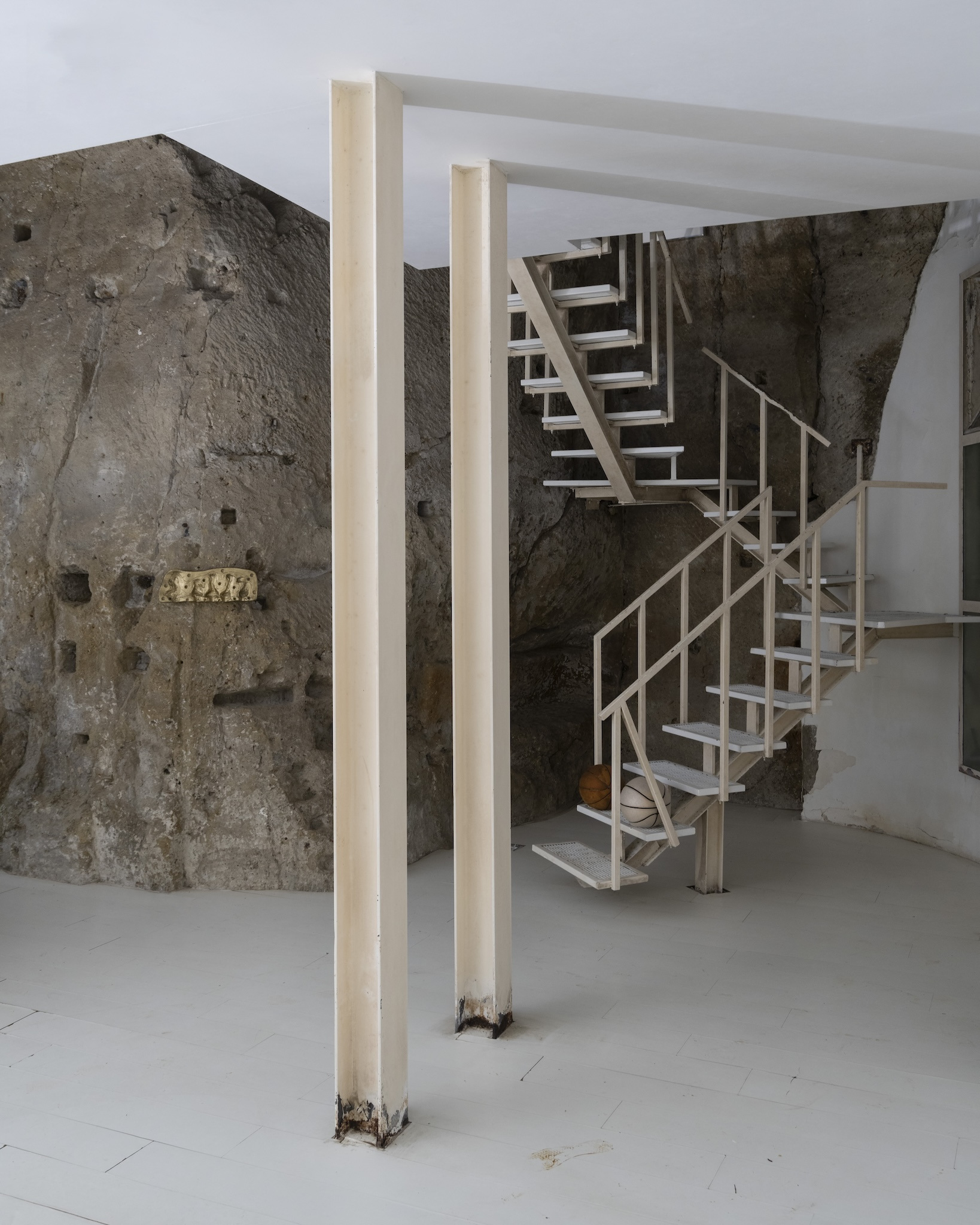
White over blue, red and yellow; exhibition view, Wschód Naples, 2026

Hélène Janicot: Untitled (2026; cardboard, scotch, paper, paint; 22 x 20 x 7 cm), Wschód Naples, 2026
White over blue, red and yellow begins with a question about the moment when abstraction ceases to be a decision and becomes a form that begins to drift away from its source, suspended somewhere between what it was and what it might become. Contemporary abstraction increasingly seems to be bound to the fragment, the trace and the temporary. Mark Godfrey writes about abstraction as a way of working with experiences that cannot be directly represented. Abstraction can emerge when matter, gesture or an object begins to slip beyond its initial function and legibility.
In Olga Balema’s practice, sculpture remains in a state of continuous transformation. She is interested in how form can emerge through its own processes, repetition, folding, deformation and the reorganisation of material. Her work maintains a direct relationship with the material while simultaneously depriving it of a fixed status. A transparent, flexible surface is shaped into a spatial structure that cannot be reduced either to a sculpture in a conventional sense.
Antonia Brown’s practice moves between sculpture, writing and film, using material processes as a way of transforming and renegotiating forms of affective reproduction. Her work is connected to family and collective histories, as well as to a feminist engagement with voice, presence and the ways in which histories are transmitted and transformed. In GG I, folded paper forms a layered, spatial composition in which individual materials and traces remain visible. Drawing, reproduction and the physical transformation of paper exist alongside one another, without a clear distinction between image and object.
Kenji Ide uses sculpture as a way of translating experiences that resist direct representation — memory, atmosphere, the passage of time and human relationships — into material form. His works emerge through the combination of elements with different qualities and origins, often through a process resembling collage. None of the materials he uses is entirely neutral: each retains its own texture, history and associations, while becoming part of a larger structure that resists a single reading. Night flows by represents a state in which memory remains fragmentary and uncertain, suspended between what has been experienced and what can still be retained.
Joanne Burke’s practice explores the relationships between the body, the environment and material processes that exist beyond human control. Her engagement with hydrofeminism and posthumanist phenomenology leads her towards forms that are difficult to separate from their natural and fluid origins. Leaf Marching takes as its starting point one of the most recognisable forms in the natural world, transforming it into a durable object through casting in aluminium. The leaf is removed from its biological function while remaining present as a trace and recognisable contour.
Adriano Costa works with objects and materials whose meaning is never entirely separate from their previous use, history and context. His practice often involves shifting things beyond their original purpose, allowing their material presence to emerge in a different way. The Fight is both a new object and a trace of an earlier work, cast in bronze from an existing sculpture mould. Repetition here does not mean simple reproduction: the form is retained while its status changes. The work moves between object and a remainder – preserving something that existed before while becoming something else.
Michael E. Smith builds his practice around objects that have been worn out, damaged or have lost their original function. He often begins with what he calls material sketches — loose arrangements of materials whose meanings he investigates through their histories, cultural associations and place within everyday circulation. In Untitled, he brings together basketballs and elements of stairs. Both are immediately recognisable, yet their combination prevents them from being fully understood according to their original purposes. Smith does not remove their meanings, but places them alongside one another until the objects become both familiar and strange.
Hélène Janicot has long been interested in peripheral forms, found objects and the ways in which the body is defined by its boundaries. In her practice, objects are often removed from everyday circulation and subjected to small yet significant shifts. Untitled (folded version) uses transport tubes and crate corners — elements originally made to protect, secure and carry other objects. In Janicot’s work, their function is suspended – what was designed to serve as protection becomes a form in its own right, demanding to be looked at rather than simply used.
Linda Lach works across sculpture, installation and video, exploring relationships between material, intimacy and recurring processes of translation. Aw-chucks! combines cut crystal glass with textile, extending across space and beginning to function as a trace of a possible action. Its elongated form resists the idea of sculpture as a self-contained object – it lives somewhere between material presence and a gesture.


